
In brief
A Silicon Valley vice president was carrying a divorce, a bankrupt employer, heartbreak and long sleepless nights. One morning a stranger in a park asked if he’d like to join her group’s exercises. That night he slept well — and Falun Gong became how he began to reduce stress.
A restless night
There’s a kind of tired that sleep doesn’t touch. You wake up already spent, and the day hasn’t even begun. If you know that tiredness, you’ll understand this morning.
It had been a restless night. For quite some time, he writes, he had battled insomnia, “had endured bouts of depression, was anxious over many issues in my life, and a lot of the time I just felt exhausted and spent.”
He was the vice president of marketing and sales at a Silicon Valley company. From the outside, a successful man.
Inside, everything seemed to be breaking at once. His marriage of 20 years had ended, and he was raising his daughters as they learned a new way of being a family. Soon after his wife left, the company he had worked at for 11 years went bankrupt. A new relationship had brought, in his words, “heartbreak and pain.”
“I wasn’t a very happy man,” he writes. “I really longed for rest and some peace and serenity in my life.”
He had not been sitting still. For years he had worked on himself — emotional healing, spiritual reconnection, looking hard at his patterns of thought and behavior. “I knew the answers lay inside myself,” he writes, “and I continued to search.”
If you’ve done all the work you know how to do and still wake up exhausted, that isn’t failure. Sometimes it means you haven’t found the right door yet.
“Would you like to join us?”
So that morning, he told himself he had to move his body and break the pattern of low energy that followed him through every day. He got dressed and walked to the park near his house, and began walking briskly around the path.
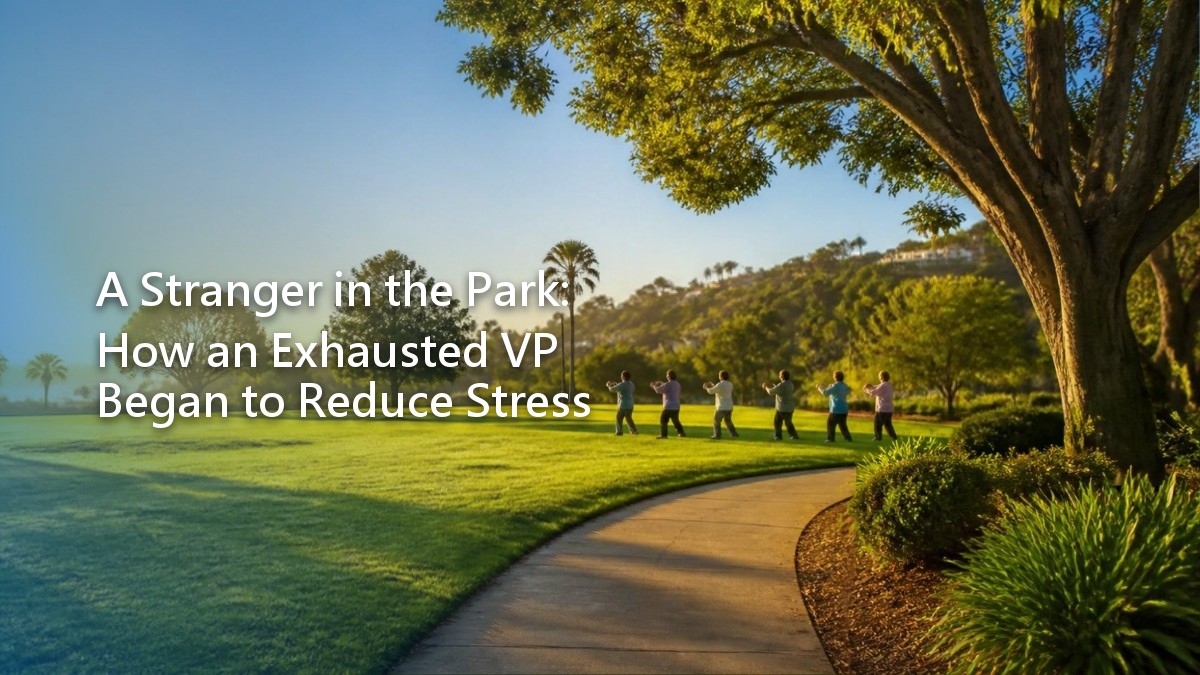
Off to his left, he noticed some people doing what looked like tai chi. As he came closer, he saw a young Chinese woman holding her hands above her head. She smiled warmly at him.
“Would you like to join us?”
“I immediately said, ‘Yes,'” he remembers. “There was just a knowingness that this was right.”
She helped him through the exercises, and afterwards showed him the first two sets he had missed. Then she invited him back the next day at 7 a.m.
That day, he noticed, he could think clearly. He felt “relaxed and at peace with the world.” That night, he slept really well.
“Well, all this sure got my attention,” he writes.
The next morning, his alarm went off at 6:15. He was already awake.

Embracing the morning
He went back the next day, and the next. Everyone, he says, was warm and friendly, and their manner was very peaceful. He did all five Falun Gong exercises with them and felt wonderful during and after. Soon he was invited to a nine-day seminar of lectures by Mr. Li Hongzhi, the founder of Falun Gong, and went eagerly.
There had been an earlier chance. A year before, his girlfriend had shown him an article about Falun Gong, and he had called a local number. He was told to come to a park far away at 5:30 a.m. and practice for two hours. “I just wasn’t ready at that time,” he admits. This time he was.
He read the Falun Gong books and found his mind “alive and stimulated.” Five simple exercises and three principles — Truthfulness, Compassion, Forbearance — began to shape his days.
If stress has been sitting in your shoulders for years, you may know how strange it feels when it starts to loosen.
The changes he describes are ordinary and very welcome. He is “much more at ease” with the challenges in his relationships and his job, and more relaxed and accepting with daily struggles. He has more clarity and focus. A lot of the stress he used to carry in his body, he says, has been released; his neck and shoulders are less tense.
“In general my life is much more peaceful,” he writes, “and things that used to cause me anxiety and worry just don’t seem to have such a strong effect on me now.”
He meets new people every week at the practice, and has felt welcomed by every one of them. Once a week he goes to a discussion group to read and talk about the teachings.
Most of all, the mornings changed. The man who used to wake up spent now writes: “I am excited about embracing the day when I awake, and I sleep much better.”
It began with a restless night and a walk in the park — and a stranger who smiled and asked if he would like to join them.
What this story may hold for you
- He had already done years of honest work on himself. Perhaps what you’ve tried hasn’t been wasted; it may be what makes you ready to say yes when the next door opens.
- Stress lives in the body too — in sleep, in the neck and shoulders. A gentle practice that moves the body may help the mind follow.
- He said no the first time it was offered. You might allow yourself not to be ready, and still stay open.
- A small kindness — a stranger’s smile, an invitation — can be where a turn begins. You may be that stranger for someone else.
- A miracle might be the body healing, or the heart letting go, or finding meaning again — or any mix of these.
A free guide for the days stress won’t let go
If this story touched something in you, there are two more like it.
Our free guide, When Stress Won’t Let Go, gathers three true stories of people who were worn down by pressure that never let up — and what slowly changed for them — with a gentle page on how to begin.
It’s free. One email with the guide, then a few short letters. Unsubscribe any time.
Free guide (PDF)
When Stress Won't Let Go
Enter your email and we'll send you the guide (PDF) right away.
We never share your email.
Questions readers ask
Q: How do I reduce stress when everything is falling apart at once?
He was facing a divorce, a bankrupt employer and heartbreak all together. What helped him began small: a walk in the park, then gentle exercises with a group every morning. Within days he noticed clearer thinking and better sleep, and over time a calmer way of meeting the same problems.
Q: How can I sleep when stress keeps me awake?
For him, the first good night came after a morning of slow exercises and the quiet that followed. He kept practicing daily and writes that he now sleeps “much better.” If sleeplessness goes on for weeks, please talk with a doctor too.
Q: Where does this story come from?
From “Company Vice-President: My Wonderful Experiences in the Practice of Falun Dafa,” chapter 26 of the eBook Hearts and Minds Uplifted, first published on Clearwisdom.net (now en.minghui.org). The author, a Western practitioner in the U.S., is not named in the book. The quotes are his own words.
A note on health
These stories share personal experiences and inner journeys. They cannot replace professional psychological or medical help. If you are in serious distress or crisis, please reach out to a qualified local counselor, doctor or crisis line.